
Context research
Why the context proxy trims the way it does, which published work shaped it, and what our own benchmark runs show. Results are interim, dated 2026-10-30; run D is complete, runs B and C are partial. Bibliography: References (OpenMem repo).
Problem
Section titled “Problem”Long agent sessions outgrow the context window. Agents handle this in one of three ways, and each fails differently:
| Approach | Failure |
|---|---|
| Keep everything | The prompt grows until the window fills, and accuracy drops as input grows (“context rot”, below). In our runs a kv-store session reached 979k tokens and never answered. |
| Native auto-compaction (LLM summary) | The summary keeps the gist but drops exact values. In our strict run it scored 0.049. |
| Trim + pointer + search (this proxy) | The agent must remember to search. Before the standing instruction, 2 of 12 trials never searched. |


Related work
Section titled “Related work”| Work | Approach | What we took | How we differ |
|---|---|---|---|
| MemGPT (Packer et al., 2023) | OS-style virtual context: a small main context plus searchable recall storage, paged in by function calls. | Verbatim recall storage behind search tools instead of a summary. | No self-editing memory; the proxy trims and the agent only searches. |
| MemGPT DMR (Table 2) and MSC-Self-Instruct | Deep memory retrieval questions over earlier Multi-Session Chat sessions. GPT-4 scored 32.1% fixed-context and 92.5% with MemGPT; GPT-4 Turbo scored 35.3% and 93.4%. | Evidence that search over stored turns beats a fixed window. | Its conversations fit in today’s windows, so it doesn’t force trimming. Not run here. |
| MemGPT nested key-value retrieval (same paper) | Multi-hop lookups across key-value pairs. Fixed-context GPT-4 and GPT-4 Turbo reach 0% by 3 nesting levels; MemGPT with GPT-4 is unaffected by nesting depth. | Closest published analogue to our kv-store task. | Not run here. |
| The Complexity Trap (Lindenbauer et al., JetBrains Research, 2025) | SWE-agent on SWE-bench Verified: observation masking (replace old tool outputs with a placeholder, keep the last 10) against LLM summarization. Masking roughly halves cost against the raw agent and matches summarization’s solve rate; Qwen3-Coder 480B scored 54.8% at $0.61 masked, 53.8% at $0.64 summarized, 53.4% at $1.29 raw. | Evidence that removal without an LLM summary is a sound default. | Masking drops only observations and keeps the agent’s reasoning and actions; we drop whole turns but keep them searchable. |
| transparent-compact: Maximising Transparency in Context Compaction Improves Retention of Facts and Commitments for Lightweight Coding Agents (Woolford, 2026-10-14) | Deterministic compaction for the Pi coding agent: user and assistant prose stays verbatim and every cut is flagged. Matched or beat Pi’s LLM-summary compaction and pi-vcc on commitment and factual-recall probes across four models, with fewer confident wrong answers; the abstract gives no numbers. | The prose-strip arm, CONTEXT_STRIP_PROSE (result). |
We strip prose only from kept turns before the strip bound; dropped turns stay searchable. |
| Compact-Bench: Measuring What Context Compaction Costs Long-Horizon Coding Agents (Sun et al., 2026-10-22) | Same repo state continued from full history or from a summary: 35 SWE-bench repairs, 146 sessions, 106 production compaction chains. Mechanical extraction kept 79.1% of recurring details against at most 16.0% for LLM summaries; detail retention did not predict task completion, and the authors conclude compaction must keep “the progress needed to complete a task”. | The progress-note arm, CONTEXT_PROGRESS_NOTE: files edited and last build/test commands, built from tool calls, no model (result). |
Our note lists only what the trim removed and rides on the pointer. |
| AutoCompact: Learning When to Compact Context in Long-Horizon Coding Agents (Zhang et al., 2026-10-01; PREreview) | A judge corrects the base agent’s compaction decisions and summaries; the corrected trajectories train coding and compaction jointly (SFT, then RL on task success). Gains held at a 256K window and at 16K with fallback compaction. The review agrees that compacting when the window fills lands mid-stage, the worst moment. | Motivation for trimming at a stage boundary. | Not built; we do not train the model. |
| CompactionRL: Reinforcement Learning with Context Compaction for Long-Horizon Agents | Trains the agent with RL to write its own compaction summaries as part of the task; consistent gains on agentic coding tasks with open models. | Nothing yet. | Learned summaries; we keep removed turns verbatim. |
| Self-Compacting Language Model Agents | Found in the same 2026-11 search; not read. | — | — |
| Letta: Is a Filesystem All You Need? (2025-08-12) | Conversation history stored as files; agent uses grep, search_files, open, close. 74.0% on LoCoMo with GPT-4o mini, against 68.5% for Mem0’s best graph variant. |
File-like tools (search, open) work well; models already use them iteratively. | Letta’s files are server-side and reached through tools. We copy that: the store is reached through MCP tools, not a shell. |
| Mainplane | Each session is one append-only state file. /continue starts a new session with “You are continuing session X. Retrieve key context from it as you go.” A standing “Context Management” system-prompt section says the previous session’s log “is searchable with rg”. |
The pointer-and-retrieve continuation, and a standing system instruction telling the agent the content exists and how to fetch it. | We trim in place, keeping the same session and prompt-cache prefix, instead of starting a new session. Access is through tools, not rg. |
| rtk | “CLI proxy that reduces LLM token consumption by 60-90% on common dev commands”; an optional rtk-proxy compresses provider-API payloads. |
Compress large tool output before the model reads it. | Our compression keeps the full text as a blob behind smart_compact_get, so nothing is lost. |
| Anthropic: Effective context engineering (2025-09-29) | “Just in time” retrieval: agents “maintain lightweight identifiers (file paths, stored queries, web links, etc.)” and load data with tools; compaction; structured note-taking. | The pointer is a lightweight identifier; the store is loaded just in time. | Anthropic’s compaction writes a summary; ours stores the removed turns verbatim. |
| Anthropic context editing and memory tool (2025-09-29) | Server-side clearing of stale tool results, plus a client-side memory directory. Internal agentic-search eval: context editing +29%, with the memory tool +39%; 84% fewer tokens in a 100-turn web-search eval. | Clearing old content without a summary helps; saving it first helps more. | We work through any provider via LiteLLM, and the removed content stays searchable. |
| Manus: Context engineering | The file system as “the ultimate context”; every compression is “restorable” because the path or URL stays. | Restorable compression: every trimmed block and compressed result keeps an id the agent can fetch. | Same principle, applied in a proxy rather than in the agent. |
| Chroma: Context Rot (2025-07-14) and repo | 18 models (GPT-4.1, Claude 4, Gemini 2.5, Qwen3). Accuracy falls as input grows, more for semantic than lexical needle matches. On LongMemEval, a ~300-token focused prompt beat a ~113k-token full prompt. | The goal: keep the active context small. Exact-match search plays to what models still do well. | Its tests are single prompts, not agent sessions. |
| LongMemEval | 500 questions over chat histories of ~115k tokens (S) or ~1.5M tokens (M); five memory abilities. | Candidate benchmark for paraphrase and semantic recall. | Not run yet. |
| LoCoMo (data) | 50 dialogues, ~300 turns and ~9k tokens each, up to 35 sessions. | Used by Letta’s result above. | Too short to force trimming. |
| ContextBench (Context Language Models, arXiv:2609.37725; Hugging Face dataset); Harbor tasks in context-language-models | Measures what an agent keeps, updates and offloads when input exceeds its window. Families: kv-store, log-triage, needle-retention, sudoku-sketchpad. Graded from the agent’s own messages, not disk. Runs on Harbor. | Our benchmark harness and tasks. | We add a strict mode (below). |
| opencode-clm (port of pi-clm) | OpenCode 1 and 2 plugin for Context Language Models. Before each request it writes the conversation to LIVE_CONTEXT.md; the model edits that file with bash (sed -i, python3), and the edited file becomes its next context. An edit gate refuses growth past the budget; an overflow guard swaps the oldest tool results for notes pointing at withheld/ files. |
Same goal as the proxy: keep the active context under a budget without an LLM summary, and keep removed text recoverable. | The model edits its own context; ours is trimmed by the proxy or plugin and searched with tools. Both register OpenCode 2 context and compaction hooks, so running both rewrites the same request; that combination is untested. |
| Hindsight | OpenMem’s reference memory provider. | Recall on trim (OpenMem integration; since removed from this package) and, in run C, semantic search. | Provider recall alone (run C’s s3d smoke test) found nearby keys rather than exact ones. |
ContextBench on this page means Shao et al.’s benchmark above, not EuniAI’s coding-retrieval ContextBench (arXiv:2602.05892).
Design decisions and their evidence
Section titled “Design decisions and their evidence”| Decision | Evidence |
|---|---|
| Store removed turns verbatim and point to them instead of summarizing | Native summary scored 0.049 in the strict run against 0.750 for smart compaction; MemGPT and Letta show search over stored turns works. |
| Standing system instruction plus a firmer pointer (“NOT in your context. You MUST call smart_compact_search…”) | Mainplane’s pattern. Trials with zero searches fell from 2 of 12 (strict) to 0 of 12 (run A). |
| Pin the first user turn | Without it, a trim dropped the task statement itself. |
| Sticky, fingerprinted cut | Later requests get the same bytes, so the prompt cache keeps hitting after a trim. Smart compaction cost $0.84 per trial in the strict run against $1.46 for keep-everything; that gap mixes cache hits with smaller prompts. |
| Calibrate the token estimate from provider-reported usage | chars/4 underestimated these streams (about 2.3 characters per token), so a 120k threshold fired at 203–236k real tokens. Built: each thread’s reported usage calibrates the estimate, with chars_per_token (2.5) before the first report (token estimate). In run D all 162 trims fired at 116.5–120.1k real tokens. |
| SQLite store: messages, lines, FTS5, hybrid ranking, read-only SQL tool | Built (context store). Run D: lookup 1.00 in all 18 log-triage trials, count 0.94 (d-sqlite) against 0 for every setting in the strict run. Letta shows file-like tools work, but shell-only access limits retrieval to coding agents; MCP tools reach any agent. sessions/<sid>.db holds every message, in context or trimmed; smart_compact_search filters by role and in_context, and smart_compact_sql answers counts and aggregates. Its lines table gives exact counts, which the old log-based line_matches could not. |
| Semantic search through the memory provider | Being measured in run C (s3c-semantic-nudged, s3d-recall). |
| Hybrid (vector) ranking in the session store | Unmeasured: in run D’s d-hybrid the agent never ran a hybrid search. |
Trim depth, CONTEXT_TRIM_TO_TOKENS (Haiku default 50000; was CONTEXT_TRIM_TO_FRACTION 0.53, and 0.3 before that) |
Make-doom trims cut about 100K to 22–31K and the agent reread files it had just read. On Terminal-Bench 2.1 the arm passed 7/8 at the lowest cost per pass; one trial per task, so not separable from the other arms. |
Prose strip, CONTEXT_STRIP_PROSE (default off; 1 on) |
transparent-compact. Not observation masking: Complexity Trap keeps each action and replaces only its output with a placeholder, while prose strip removes the tool call and its result with no marker in place; the paper does not test that. Efficacy under review. Terminal-Bench 2.1: 6/8. |
Progress note, CONTEXT_PROGRESS_NOTE (default on; 0 off) |
Compact-Bench. Terminal-Bench 2.1: 6/8; the note never decided a trial (see there). |
Benchmark method
Section titled “Benchmark method”| Item | Setting |
|---|---|
| Harness | Harbor running ContextBench tasks through Claude Code (2.1.312) in headless mode |
| Model | Claude Haiku 5.5 through LiteLLM v1.106.6 (run D: v1.109.0-dev.1, the context-proxy pin) |
| Tasks | kv-store (stream SET batches, then GETs) and log-triage (log batches, then lookup and count questions); sizes R1000/R4000/R16000 and L1600/L6400/L12800 |
| Strict mode | Bash and file tools disabled. The first pilot scored 1.0 on every arm because the agent wrote values to a file in /tmp and grepped them back, so it measured the disk, not the context. |
| Settings (arms) | s1-none keep everything; s2-native Claude Code auto-compaction; s3a-smart proxy trim + search tools; s3b-smart-nocomp the same without tool-result compression; run C adds s3c-semantic-nudged and s3d-recall; run D’s d-sqlite and d-hybrid are below |
| Proxy settings | trim at 120,000 estimated tokens, compress tool results over 4,000 |
| Scoring | reward is ContextBench’s score. kv answers must include a random #hex tag that Haiku often drops; reward_lenient also accepts an otherwise-correct answer without the tag. A trial that dropped the tag was rerun once. |
| Concurrency | 8 trials at once in the strict run, at most 4 in runs A–D |
Runs were executed with the OpenMem bench harness (bench/); this package ships the same trimmer code path.
Results (interim, 2026-10-29 to 2026-10-30)
Section titled “Results (interim, 2026-10-29 to 2026-10-30)”Strict run (complete; 24 trials, kv-store-R4000 and log-triage-L6400, seeds 42–44)
Section titled “Strict run (complete; 24 trials, kv-store-R4000 and log-triage-L6400, seeds 42–44)”| Setting | reward | reward_lenient | $ per trial | Peak prompt | Native compactions | Trims | Searches per trial |
|---|---|---|---|---|---|---|---|
| s1 keep everything | 0.562 | 0.729 | 1.46 | 371k | 0 | 0 | — |
| s2 native | 0.049 | 0.049 | 0.47 | 121k | 3.7 | 0 | — |
| s3a smart | 0.750 | 0.750 | 0.84 | 214k | 0 | 1.5 | 12.7 |
| s3b smart, no compression | 0.611 | 0.611 | 0.85 | 220k | 0 | 1.0 | 7.3 |
No tool result crossed the 4,000-token threshold, so compression never ran and s3a and s3b were the same configuration; their gap is run-to-run variance. The count half of log-triage scored 0 in every setting.
Run A: standing instruction and line_matches (first attempts complete; two tag-drop reruns pending)
Section titled “Run A: standing instruction and line_matches (first attempts complete; two tag-drop reruns pending)”Same tasks and seeds as the strict run, s3a and s3b only.
| Metric (s3a + s3b, 12 trials) | Strict run | Run A |
|---|---|---|
| Trials with zero searches | 2 | 0 |
| kv-store reward_lenient, mean | 0.91 | 1.00 |
| log-triage lookup, mean | 0.90 | 1.00 |
| log-triage count, mean | 0 | 0.07 |
| log-triage reward, mean | 0.45 | 0.53 |
Run A used the earlier JSONL handoff log. Its line_matches counted only rows already trimmed into the log, so counts missed lines still in context (348 returned against a true 594), shifted between trims (111, then 184, against 171) and sometimes overcounted. The SQLite store replaces that log: line_matches now counts the lines table across the whole session, and smart_compact_sql answers counts directly. Run D benchmarks both.
Run B: score against size (partial; mostly seed 42)
Section titled “Run B: score against size (partial; mostly seed 42)”| Task, size | s1 keep everything | s2 native | s3a smart |
|---|---|---|---|
| kv R1000 | 1.00 (96k) | 1.00 (97k) | 1.00 (98k) |
| kv R4000 | 1.00 (358k) | 0.04 (120k) | 1.00 (204k) |
| kv R16000 | 0.00, hit step limit at 979k | 0.00 (119k, 12 compactions) | 1.00 (204k) |
| log L1600 | 0.71 (lookup 1.00, count 0.42; 178k) | 0.50 (lookup 1.00, count 0; 120k) | 0.50 (lookup 1.00, count 0; 157k, no trim) |
| log L6400 | 0.42 (lookup 0.83, count 0; 386k) | 0.13 (lookup 0.25; 121k) | 0.63 (lookup 0.92, count 0.33; 234k) |
Peak prompt tokens in parentheses. Keep-everything loses lookups and counts as the log grows (context rot); smart compaction holds lookups with a prompt about 40% smaller.
Run D (SQLite store, calibrated trim; complete, 36 trials)
Section titled “Run D (SQLite store, calibrated trim; complete, 36 trials)”Run 2026-10-29 to 2026-10-30. Strict mode, Haiku 5.5, trim at 120,000 tokens (calibrated estimate), tasks kv-store R1000/R4000/R16000 and log-triage L1600/L6400/L12800, seeds 42/43/44.
| Setting | Code | Store and search |
|---|---|---|
d-sqlite |
commit 4dded1d | sessions/<sid>.db, lexical search and smart_compact_sql; no vectors |
d-hybrid |
commit 2ec584e (adaptive embedding batches) | the same plus vectors from nomic-embed-text through Ollama on an iGPU |
Scores are tag-insensitive (reward_lenient). † marks a kv trial whose strict reward was 0 because every answer dropped the #tag; the values were right. Six first attempts (d-sqlite kv R4000 s43, R16000 s43 and s44; d-hybrid kv R1000 s42–s44) were moved to invalid/ and rerun once; four of the six reruns dropped the tag again.
| Task | d-sqlite s42 / s43 / s44 | d-hybrid s42 / s43 / s44 | Trims | Peak prompt |
|---|---|---|---|---|
| kv R1000 | 1.00 / 1.00 / 1.00 | 1.00 / 1.00† / 1.00† | 0 | 99–101k |
| kv R4000 | 1.00 / 1.00† / 1.00 | 1.00 / 1.00 / 1.00 | 3 | 119k |
| kv R16000 | 1.00 / 1.00 / 1.00† | 1.00 / 1.00 / 1.00 | 13 | 119k |
| log L1600 | 0.96 / 1.00 / 0.75 | 0.96 / 0.92 / 1.00 | 1 | 117–120k |
| log L6400 | 1.00 / 1.00 / 1.00 | 1.00 / 0.67 / 1.00 | 3 | 118–120k |
| log L12800 | 1.00 / 1.00 / 1.00 | 1.00 / 0.54 / 1.00 | 7 | 118–120k |
| Mean (18 trials per setting) | d-sqlite | d-hybrid |
|---|---|---|
All tasks, reward_lenient |
0.984 | 0.949 |
All tasks, strict reward |
0.873 | 0.838 |
kv-store, reward_lenient |
1.000 | 1.000 |
| log-triage lookup | 1.000 | 1.000 |
| log-triage count | 0.935 | 0.796 |
All 162 trims fired at 116,539–120,079 real prompt tokens, against 203–236k under the old chars/4 estimate. The largest prompt in any trial was 120,079 tokens. kv R1000 never reached the threshold.
Lookups were perfect. Every lost point is a count question, in six trials. Two failure modes explain four of them; both are known and not yet fixed:
- Echo overcount.
smart_compact_sqlcounts the session’s lines, and those include the agent’s own tool output and answers, which repeat log lines. The repeats are counted again, giving overcounts of +1 to +8: d-sqlite L1600 s44 (count 0.50), d-hybrid L1600 s43 (0.83) and L12800 s43 (0.08). - No SQL. On some count questions the agent answered without calling SQL: d-hybrid L6400 s43 used SQL on 6 of 12 count questions and scored 0.33.
The single missed count in L1600 s42 is the same question in both settings (gold 46, answer 45). The question is scoped narrower than all matching lines: the agent’s first SQL count over every user line returned 174, and its follow-up queries grouped matches by message (the pinned first user turn holds 2). Its final answer was one short; which scoping step went wrong is not confirmed.
The agent never ran a hybrid search. All 337 smart_compact_search calls across both settings ran lexical, using exact patterns or lexical queries for exact ids, and counts went through 307 smart_compact_sql calls. Run D therefore does not measure vectors, and d-hybrid’s lower count mean comes from the failures above, not from embedding. The single-thread embedder also lagged under 4 concurrent sessions: at the end of the run 6 of the 15 trimmed d-hybrid databases had a vector for every row and the other 9 had none.
Cost at list price: $16.60 for run D, $9.12 for d-sqlite and $7.48 for d-hybrid (about $0.51 and $0.42 per trial).
Against run B’s baselines (mean score; n = completed seeds; run B trials had no tag drops):
| Task | s1 keep everything | s2 native | d-sqlite (n = 3) | d-hybrid (n = 3) |
|---|---|---|---|---|
| kv R1000 | 1.00 (n = 1) | 1.00 (n = 1) | 1.00 | 1.00 |
| kv R4000 | 1.00 (n = 2; 358k) | 0.04 (n = 1) | 1.00 | 1.00 |
| kv R16000 | 0.00, step limit at 978–979k (n = 2) | 0.00 (n = 1) | 1.00 | 1.00 |
| log L1600 | 0.71 (n = 1; count 0.42) | 0.50 (n = 1; count 0) | 0.90 (count 0.81) | 0.96 (count 0.92) |
| log L6400 | 0.46 (n = 2; count 0) | 0.08 (n = 2; count 0) | 1.00 (count 1.00) | 0.89 (count 0.78) |
| log L12800 | 0.38 (n = 1; count 0; 765k) | no completed trial | 1.00 (count 1.00) | 0.85 (count 0.69) |
Run D keeps every prompt under 121k, where keep-everything grew to 979k, and keeps exact values that native compaction lost.
Telling the model it can search after a trim (run “Dp”, 5 trials)
Section titled “Telling the model it can search after a trim (run “Dp”, 5 trials)”Run 2026-10-30 on one task: log-triage L1600 seed 44, smart compaction (d-sqlite) only, five repeats.
The earlier version (commit 5e77a2b) trims at 95k for Haiku. On this task the model never searched its trimmed history afterwards and answered 16 of the 24 questions UNKNOWN. This version (commit f1fd9f3) changes one thing: the note left in place of the trimmed messages now names the smart_compact_search and smart_compact_sql tools and says they are available.
| Trial | Search calls | SQL calls | UNKNOWN | Score | Lookup | Count |
|---|---|---|---|---|---|---|
| Before the change (5e77a2b) | 0 | 0 | 16 | 0.17 | 0.33 | 0.00 |
| With the change, trial 1 | 6 | 10 | 0 | 1.00 | 1.00 | 1.00 |
| With the change, trial 2 | 8 | 10 | 0 | 1.00 | 1.00 | 1.00 |
| With the change, trial 3 | 8 | 16 | 0 | 0.71 | 1.00 | 0.42 |
| With the change, trial 4 | 12 | 13 | 0 | 1.00 | 1.00 | 1.00 |
| With the change, trial 5 | 14 | 15 | 0 | 1.00 | 1.00 | 1.00 |
With the note naming the tools, every trial searched after the trim and answered every question. Mean score 0.94; all 7 lost points are trial 3’s count questions.
Keeping the prompt cache intact after a trim (run “Df”, 5 trials)
Section titled “Keeping the prompt cache intact after a trim (run “Df”, 5 trials)”Same task and setup, run 2026-10-30. This version (commit 47d17fa) builds on the search-tools note above and changes how a trim treats the model’s thinking blocks. It drops the thinking from before the trim and keeps the thinking from after it. The start of the prompt then stays byte-for-byte the same from one request to the next, so the provider’s prompt cache keeps hitting instead of being rewritten.
| Trial | Trims | Tokens written to cache | Cache hit rate | Cost | Score |
|---|---|---|---|---|---|
| Trial 1 | 1 | 229k | 0.967 | $0.122 | 1.00 |
| Trial 2 | 1 | 154k | 0.979 | $0.110 | 1.00 |
| Trial 3 | 1 | 140k | 0.979 | $0.101 | 1.00 |
| Trial 4 | 1 | 147k | 0.979 | $0.105 | 1.00 |
| Trial 5 | 1 | 145k | 0.979 | $0.103 | 1.00 |
| Mean, with the cache fix | 1 | 163k | 0.976 | $0.108 | 1.00 |
| Mean, search-tools note only | 1–3 | 598k | 0.919 | $0.218 | 0.94 |
The cache fix halves the mean cost, from $0.218 to $0.108, and every trial scored 1.00. Most of the cost gap comes from one search-tools-only trial (trial 5). It trimmed 3 times, wrote 2.2M tokens to the cache at a 0.693 hit rate, and cost $0.589. Without that trial the search-tools-only mean is $0.126. No cache-fix trial behaved that way, but five trials cannot rule it out. Every trial in both runs kept its largest prompt under 95k tokens.
Run E: held-out seed-matched comparison
Section titled “Run E: held-out seed-matched comparison”Run E used Haiku 5.5, Claude Code strict mode, the same proxy build, and seeds 45–47 for each arm. The primary arms were e-none (no compaction), e-native (Claude Code default), and e-smart (Smarter Compact SQLite search, 95k Haiku threshold, search-tools pointer and cache-stable trim). Tasks were kv R4000 and log L1600/L6400/L12800. Keep-everything has only seeds 45–46 at L12800. e-native-153k is a sensitivity arm and is excluded from the primary chart. e-native never compacted: 0 compactions in 12 trials, peak prompt 764,310 tokens at L12800, below Claude Code’s default Haiku 5.5 auto-compact point of about 967K. It is a second keep-everything arm, labelled “default native (never compacted)” below. Raw rows are in openmem bench/results-E/summary.json; the published chart is on this site.
The paired log-score advantage was +0.469 against keep-everything (95% bootstrap interval 0.339–0.578, eight pairs) and +0.495 against default native, which never compacted (0.384–0.593, nine pairs). Kv R4000 scored 1.0 in all arms. Smart/none cost ratios were 0.130 [0.128, 0.132] at kv R4000, 0.811 [0.102, 1.528] at log L1600, 0.109 [0.107, 0.111] at L6400, and 0.062 [0.062, 0.063] at L12800. The L1600 interval crosses 1. The evidence plan gives each size’s score and wall-time interval and explains the bootstrap method.
Deviations from the pre-registration
Section titled “Deviations from the pre-registration”The evidence plan as committed before run E (openmem dbdf5ce, 2026-10-30 18:52 EDT; the first run E trial in results-E started 19:11) differs from the reported analysis in two ways:
- H1 named kv R4000, log L6400 and log L12800. The headline pools log L1600, L6400 and L12800: it adds L1600 and drops R4000, where every arm scored 1.0.
- The plan specified 10,000 bootstrap resamples; the reported intervals use 20,000.
The +0.469 [0.339, 0.578] interval resamples the 8 log-triage pairs as if independent, but all 8 come from one task family at three sizes. A task-clustered bootstrap resamples the three sizes (L1600, L6400, L12800) with replacement, then seed pairs within each drawn size (20,000 resamples, RNG seed 0). It gives +0.469 [0.329, 0.639] against keep-everything and +0.495 [0.352, 0.648] against default native. With three clusters this interval is coarse. Both intervals reproduce in openmem with cd bench && python3 ci.py results-E/summary.json --metric reward_lenient --pool log-triage (add --ref e-native for the native comparison).
Sensitivity arm: native compaction at a 153K window (e-native-153k)
Section titled “Sensitivity arm: native compaction at a 153K window (e-native-153k)”e-native-153k set CLAUDE_CODE_AUTO_COMPACT_WINDOW=153000, which made Claude Code compact near 120K tokens (logged pre-compaction sizes 119,447–132,191). It ran the same 12 tasks and seeds; no trial was excluded. Rows are in the same summary.json.
| Task, size | Score (smart / native-153k / default native / keep) | List-price cost per trial (smart / native-153k) | Native compactions per trial | Peak prompt (smart / native-153k) |
|---|---|---|---|---|
| kv R4000 | 1.000 / 0.042 / 1.000 / 1.000 | $0.14 / $0.39 | 4.0 | 93,156 / 119,677 |
| log L1600 | 1.000 / 0.333 / 0.583 / 0.569 | $0.36 / $0.29 | 1.0 | 94,489 / 121,891 |
| log L6400 | 0.875 / 0.028 / 0.458 / 0.486 | $0.20 / $0.36 | 3.0 | 95,771 / 122,939 |
| log L12800 | 1.000 / 0.028 / 0.347 / 0.354 | $0.38 / $1.04 | 8.3 | 95,403 / 122,856 |
Three seeds per cell, except keep-everything at L12800 (two). Across nine log pairs smart minus native-153k was +0.829 (pairs bootstrap [0.676, 0.958]; task-clustered [0.625, 0.981]); native-153k minus keep-everything was −0.349 over eight pairs ([−0.510, −0.182]). Reproduce with python3 ci.py results-E/summary.json --metric reward_lenient --pool log-triage --ref e-native-153k.
Sonnet 5 has two paired log L6400 seeds. Smart minus none score was +0.0625 [0.0417, 0.0833]; its cost ratio was 0.401 [0.361, 0.441]. The two smart trials cost $7.86 at list price against $19.85 for none. This supports the direction on that one task, with too few seeds for broad model claims.
The coding-task replay used Haiku 4.5. Its step2c brief required changing strings pinned by existing exact-string tests while forbidding assertion edits; all four step2c trials therefore report tests_rc=1. Two of four smart-arm replays searched the session store once. This does not diagnose the earlier hour-long subagents, whose transcripts were not scored for scratchpad behavior. The decision-consistency trial set remains partial. Scratchpad read-path work is outside main, so no scratchpad benefit is claimed here.
Run G: current defaults against run E baselines (2026-11-09)
Section titled “Run G: current defaults against run E baselines (2026-11-09)”Smart compaction at v0.9.0 (commit 3acd9b5) cost 0.155 times as much as keeping everything, averaged over four task sizes: an 85% saving, against 72% in run E. Run G reran only e-smart, with run E’s model (Haiku 5.5), harness (Claude Code strict mode), tasks (kv R4000, log L1600/L6400/L12800), seeds (45–47) and the 95k Haiku threshold. The keep-everything and default native rows are run E’s; neither arm runs Smarter Compact code, so they still apply. Since run E the smart arm gained input clearing, the reasoning strip, reuse rules, dedup pointers, kept errors, log reduction, notes as system messages and the scratchpad; the ledger is off. The bench allowed smart_compact_scratchpad next to the three search tools and gave the MCP server a writable store. All 12 trials wrote a pad, 1 to 11 times each. Trials ran against a frozen export of main through openmem bench/run_ctx.sh run G; rows are in openmem bench/results-G/summary.json. Run F (2026-11-04, commit 0a7b3ee) was an unpublished check of the same arm.
| Task, size | Pairs | Smart/none cost ratio, run G | Run E | Smart score, run G / run E | Smart cost per trial, run G / run E |
|---|---|---|---|---|---|
| kv R4000 | 3 | 0.140 [0.138, 0.141] | 0.130 [0.128, 0.132] | 1.000 / 1.000 | $0.15 / $0.14 |
| log L1600 | 3 | 0.318 [0.092, 0.559] | 0.811 [0.102, 1.528] | 1.000 / 1.000 | $0.16 / $0.36 |
| log L6400 | 3 | 0.102 [0.101, 0.104] | 0.109 [0.107, 0.111] | 0.861 / 0.875 | $0.19 / $0.20 |
| log L12800 | 2 | 0.059 [0.058, 0.060] | 0.062 [0.062, 0.063] | 1.000 / 1.000 | $0.49 / $0.38 |
| Mean of four ratios | 0.155 (85% saving) | 0.278 (72% saving) |
Each ratio is the mean of per-seed smart/none list-price cost ratios; its interval bootstraps the pairs (20,000 resamples, RNG seed 0, ci.py’s boot_ci). Score and cost per trial average three seeds; L12800 has two pairs because keep-everything has only seeds 45–46. The unpaired L12800 seed 47 cost $0.74 and took 37 minutes, with 16 trims. Every interval now lies below 1; run E’s L1600 interval crossed it.
The paired log-score advantage was +0.464 against keep-everything (95% bootstrap interval 0.339–0.573, eight pairs; task-clustered 0.324–0.639) and +0.491 against default native (0.361–0.597, nine pairs; task-clustered 0.329–0.648). Run E gave +0.469 and +0.495. The one score below 1.0 was L6400 seed 46: lookups 1.00, counts 0.17. Paired smart/none agent-wall-time ratios were 1.086 [1.003, 1.149] at R4000, 1.290 [0.501, 2.210] at L1600, 0.941 [0.892, 1.005] at L6400 and 0.879 [0.708, 1.050] at L12800. The 12 trials cost $2.95 at list price.
SWE-bench boundary: where the effect does not reach (2026-11-03)
Section titled “SWE-bench boundary: where the effect does not reach (2026-11-03)”bench/swebench runs the Complexity-Trap arms on SWE-bench Verified: none keeps everything, smart trims and gets the recall tools. The 45-instance set, hard45, holds Verified instances labelled one-to-four-hours-plus to fix. With Qwen 3.8 Flash (self-hosted, via the cairn2 endpoint) the none arm resolved 45/45, so the quality endpoint is pinned at 100% before any arm is measured.
Trimming at 40k on that set (35 trials, stopped 2026-11-03) brought no gain. none resolved 19/19 and smart 15/16, with zero smart-only wins and one none-only loss. Requests rose from 303 to 373 (+23%) with steps flat, and wall clock rose 17–59%. Per-trial cost stayed the same across TRIM_AT 17k→40k. Twenty-nine recall calls happened unprompted, so the pointer drives retrieval even with nothing at stake.
That is a boundary, not a refutation, and the reason is the context distribution. Peaks on those tasks: median 34.5k (none) and 26.9k (smart), p90 59k and 39k, max 77k and 44k. Every documented effect above lives between 116k and 979k, and the shipped per-model thresholds are 95k (Haiku) and 125k (default). A 40k trim against a 120k-calibrated effect, on tasks whose history the agent can re-read off disk, cannot produce it.
Two measurement rules came out of this:
- A provider that reports
cacheseparately makestotala count of tokens processed, not tokens billed.cairn2reportedinputwithcache: {read: 0}while the API put 10.64M of 10.75M prompt tokens (99%) incache_read. Token-derived cost on such an endpoint is meaningless; use wall clock and request counts, and measure cost on a real API where caching is implemented. - Launch a run as a harness-owned background process.
nohup … &inside a foreground call belongs to that call’s process group and dies with it, silently: a chained smoke run lost its parent mid-scoring with no traceback, nometa.json, and an orphaned scoring container, which read as “scoring is slow” for ten minutes.
Chained SWE sessions: manufacturing a long horizon (protocol, 2026-11-03)
Section titled “Chained SWE sessions: manufacturing a long horizon (protocol, 2026-11-03)”SWE-bench’s unit of work is too short to reach the regime, so --chain makes the session longer instead: instances are grouped by repo and a repo’s tasks run back to back in one OpenCode session, scoring each task separately.
Per task: a fresh container on that instance’s own base commit, opencode run --session <previous task's session id>, patch captured, then git reset --hard && git clean -fdq before the next task. What persists across containers is the agent home and the trim ledger on the host (_chains/<arm>-<repo>-<run>/, symlinked into each trial dir as home/state), which is what makes the conversation and the compaction state grow monotonically. Task 2 onward gets a preamble stating the tree was reset and earlier tasks are gone. Chain order is sorted instance ids, identical for both arms.
Per-trial scoring stays inside the chain: in the flat run it cost 26s median on django and 95s on astropy (trial wall minus agent wall), which buys a resolved tied to the task that earned it. A first attempt deferred it because a django score seemed to take ten minutes. That was an orphaned scoring container, left behind when a killed parent stopped reading it. It is recorded here because the artifact nearly reshaped the protocol. --defer-score exists for suites that really are the long pole.
Confound to state in any result: chaining lets the none arm recall an earlier task’s fix, which biases toward keep-everything. A smart arm that ties or wins under that bias is the strong result. Gate before spending: max_prompt_tokens must rise task over task, the session must resume across containers, and a spot-check of one deferred score must confirm the reset left each patch valid.
Seeded plan (not run). run-chain-seeds.sh runs the chain-django8 set (first 8 django ids of hard45.json) as one chain per arm (none, smart) per seed, seeds 1–3 by default; --chain-seed shuffles each repo’s order, the same for both arms, and each seed has its own run id. Trim at 40K: the flat hard45-cairn-40k smart arm trimmed one or two times on 6 of these 8 tasks, and chained django peaks grew about 15K per task (chain-smoke-5: 27,092 → 42,868 → 57,747), so each 8-task chain should cross 40K at least three times. The gate is trims ≥ 3 per smart chain in chain_report.py.
Terminal-Bench 2.1: trim-shape arms (2026-11-05)
Section titled “Terminal-Bench 2.1: trim-shape arms (2026-11-05)”Claude Code on claude-haiku-5-5 through Harbor (bench/termbench/harbor), smarter-compact trimming at 95K, Claude Code’s own auto-compact window at 195K. Four arms, one trial each on eight long Terminal-Bench 2.1 tasks; each arm is a sc_agent_claude class whose env sets the knobs. The first job (tb21-h55-arms) lost 24 of 32 trials to an expired OAuth token; those 24 were rerun as tb21-h55-arms-r3. Baseline columns are the same tasks from tb21-h55-rerun, default settings.
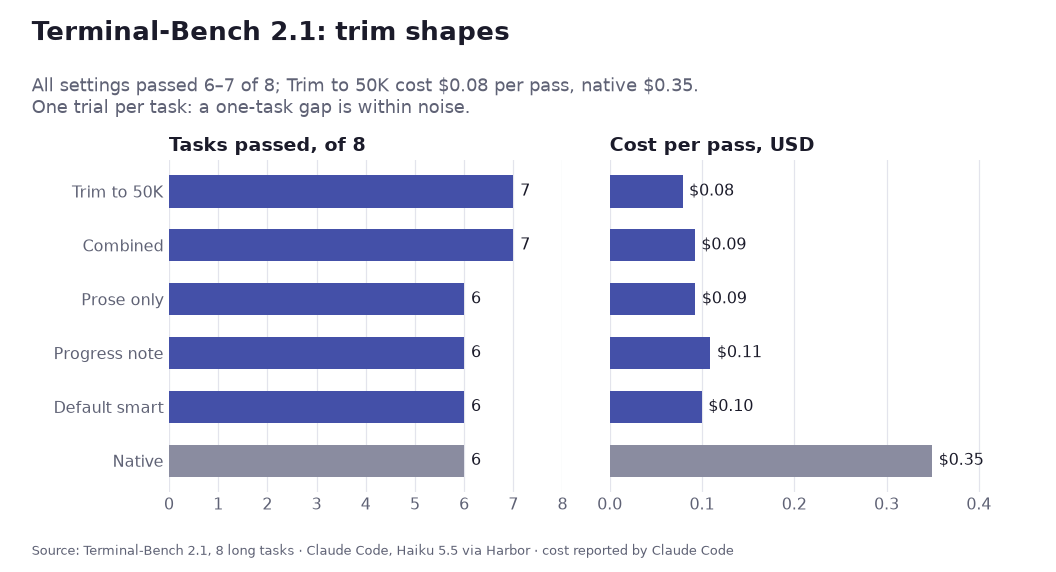
Chart: plot_arms.py from tb21-h55-arms.json.
| Task | Progress note | Trim to 50K | Combined | Prose only | Default smart | Native |
|---|---|---|---|---|---|---|
| adaptive-rejection-sampler | 1 | 1 | 1 | 1 | 1 | 1 |
| fix-ocaml-gc | 1 | 1 | 1 | 1 | 1 | 1 |
| make-doom-for-mips | 0 timeout | 0 timeout | 0 timeout | 0 timeout | 0 timeout | 0 |
| make-mips-interpreter | 0 | 1 | 1 | 0 | 1 | 0 |
| path-tracing | 1 | 1 | 1 | 1 | 1 | 1 |
| path-tracing-reverse | 1 | 1 | 1 | 1 | 0 | 1 |
| regex-chess | 1 | 1 | 1 | 1 | 1 | 1 |
| schemelike-metacircular-eval | 1 | 1 | 1 | 1 | 1 | 1 |
| Passed | 6/8 | 7/8 | 7/8 | 6/8 | 6/8 | 6/8 |
| Cost (Claude Code-reported) | $0.655 | $0.553 | $0.646 | $0.557 | $0.599 | $2.097 |
| Cost per pass | $0.109 | $0.079 | $0.092 | $0.093 | $0.100 | $0.350 |
| Requests | 203 | 168 | 188 | 148 | ||
| Cache read / write / output tokens | 9.11M / 0.90M / 0.61M | 6.87M / 0.74M / 0.52M | 8.04M / 0.82M / 0.60M | 6.32M / 0.74M / 0.56M |
- Arms: Trim to 50K sets
CONTEXT_TRIM_TO_FRACTION=0.526; prose only setsCONTEXT_STRIP_PROSE=1; progress note setsCONTEXT_PROGRESS_NOTE=1; combined sets all three. - Trims: 26 of 32 trials trimmed once or twice. Peaks stayed at or under 97K except regex-chess (101–124K before its trim). 90.5% of input tokens were cache reads.
- Failures: every arm timed out on make-doom-for-mips. Progress note and prose only failed make-mips-interpreter on the image-similarity check (about 0.76 against 0.95).
- Costs are the
total_cost_usdClaude Code reported, recorded by Harbor; not checked against list prices. The make-doom timeouts have Harbor’s figure only.
Why the progress note shows nothing here. The note never decided a trial:
- Its one failure, make-mips-interpreter, trimmed once, and that trim’s ledger has no progress section, so the model never saw a note. Prose only failed the same task on the same check with no note at all.
- 8 of the 16 progress and combined trials carried a progress section. Each trial trimmed at most twice, so the note appeared once or twice per session.
- At the first trim the dropped turns are mostly exploration: the notes list
which gcc objdump …-> ok, or one edited file the agent canls. Compact-Bench’s “progress” is the state of a long repair after many compactions; a session trimmed once has little of it to lose, and Terminal-Bench state lives on disk where the agent rereads it. - One trial per cell: a single flipped result moves an arm by 1/8, the whole spread between arms.
Testing the note needs sessions that trim many times (a lower threshold or longer tasks) and repeat attempts on the tasks that split. Raw rows: /tmp/opencode/tb21-h55-usage.jsonl (local, not committed).
Prose strip versus observation masking (2026-11-05)
Section titled “Prose strip versus observation masking (2026-11-05)”Offline replay of the trim-shape arms’ session databases (no model calls). Each trimmed request was rebuilt from its stored rows and prose_ids run on it, with every message counted as kept (an upper bound on what could be stripped). The trials ran proxy code cb74353.
| What | Result |
|---|---|
| Tool pairs prose strip removed | 0 in all 31 trims (prose, combined, progress, trim-to-50K, default) |
| Why | Claude Code sends a system message after each tool result (<total_tokens>…, # Environment update), 7 to 65 per trimmed request; _prose_region never strips the item before a system message, so no result is eligible |
Pairs CONTEXT_MASK_OBSERVATIONS would mask on the same requests (current code) |
2 to 63 per trim; 10 on prose-only make-mips-interpreter |
| Tokens saved by strip versus cut | all of each trim’s drop came from the cut (for example 95,946 to 55,689 on prose-only make-mips-interpreter) |
| Cut-dropped tool calls the agent ran again later (same Bash command or Read path) | 2 of 341 across all arms |
| make-mips-interpreter failures (prose only, progress note) | not caused by stripping: nothing was stripped, and progress note has no strip. Both trimmed once while exploring, wrote the interpreter afterwards with its own steps in context, and missed the image check (0.762, 0.760 against 0.95) |
So the prose-only and combined arms measured the cut, not prose strip, on Claude Code. One trial per cell; the data cannot rank the strip shapes. Masking replaces only result text, so roles and message order stay as they are and it skips the before-system rule.
Bench plan (not run). Claude Code on claude-haiku-5-5, trim depth 0.53, three arms: no strip (ScClaudeNoStrip, CONTEXT_STRIP_PROSE=0), prose strip (ScClaudeProse), masking (ScClaudeMask, CONTEXT_MASK_OBSERVATIONS=1); each class forwards its knob through ARM_ENV_KEYS in sc_agent_claude.py. On Claude Code the prose arm equals no strip until the before-system rule changes, so it is a check, not a contrast. Trim at 60K (CONTEXT_TRIM_AT_TOKENS=60000 in each agent’s env; job tb21-h55-strip60k.json) so sessions trim three or more times. Tasks: make-doom-for-mips, schemelike-metacircular-eval, path-tracing-reverse (each trimmed two or three times at 95K), make-mips-interpreter (split across arms), path-tracing. Five trials per cell: 5 tasks × 3 arms × 5 = 75 trials. On these five tasks the tb21-h55-arms-r3 arms (trim 95K) cost $0.053 to $0.082 per trial (5 trials each, harbor cost_usd), so 75 trials cost about $4 to $6; ten trials per cell, about $8 to $12. Pass rate at this n separates only large effects; the primary measures are per trim: pairs masked or stripped, later repeats of a masked call, recall tool calls, and tokens per trial.
Mechanism plan (not run). Same model and five tasks, trigger 60K, four arms in job tb21-h55-mech60k.json: smart (ScClaudeSmarterCompact); trim without search tools (ScClaudeNoRecall: recall MCP server unregistered, standing instruction off), which separates the archive from the shorter prompt; Anthropic context editing (ScClaudeServerClear: CONTEXT_SERVER_CLEAR=1, clear_tool_uses_20250919 at 60K, keep 3, clear at least 5,000, our trim off); and Claude Code’s summarizing compaction lowered to about 60K (ScClaudeNativeLow: CLAUDE_CODE_AUTO_COMPACT_WINDOW=100000, the documented minimum, with CLAUDE_AUTOCOMPACT_PCT_OVERRIDE=60). report.py counts compact_boundary events (column compacts) and trials whose init event offered a smart_compact tool (column tools), so each arm’s mechanism is checked per trial. ScClaudeNoRecall needs a proxy setting that drops tool directions from the trim pointer (proposed CONTEXT_POINTER_TOOLS=0); ScClaudeServerClear needs CONTEXT_SERVER_CLEAR. Both arms fail at install until the mounted proxy reads those settings.
Constraint probe: rules in dropped user turns (2026-11-05)
Section titled “Constraint probe: rules in dropped user turns (2026-11-05)”Does the agent still follow a rule after a trim drops the turn that stated it? Claude Code on claude-haiku-4-5-20251001, trim at 20,000 tokens (the other benches here used Haiku 5.5, so this result is not directly comparable with them); turn 2 says “Never modify anything under tests/”, filler turns force the trim, the last turn asks to make a deliberately conflicting test suite pass. Arms: the pointer with the sentence “Dropped user turns may hold instructions or corrections that still apply” (df3f81f) and without it (26d2040). Harness and commands: bench/probe/constraint.
| Arm | Runs | Rule turn trimmed | Searched before editing | Rule came back from recall | Searched with role="user" |
Edited tests/ | Told the user about the conflict |
|---|---|---|---|---|---|---|---|
| With the sentence | 5 | 5 | 5 | 5 | 4 | 0 | 4 |
| Without it | 5 | 5 | 5 | 5 | 1 | 1 | 4 |
Recall brought the rule back in all 10 runs. The one violation without the sentence edited the test after the rule appeared in a search result; the one miss with it special-cased the input in src/pricing.py and did not report the conflict. At n=5 the sentence changes how the agent searches (4 of 5 against 1 of 5 by role="user"), not measurably whether it obeys. The setup favours recall: the rule sits two turns back and most queries (“test suite failing”) surface it as neighbouring context. Cost $7.94 (Claude Code total_cost_usd).
Cache after a cut, with thinking (2026-11-05)
Section titled “Cache after a cut, with thinking (2026-11-05)”Question. Does the proxy’s cut invalidate Anthropic’s prompt cache when the session carries extended thinking blocks? Probe: bench/probe/cache-thinking/. Claude Code 2.1.280, claude-haiku-5-5 through a proxy from this tree at CONTEXT_TRIM_AT_TOKENS=55000; ten claude -p --resume turns per session, each turn after the first reading one 5K-token file. n = 2 sessions, 2 cuts each, 4 cuts. Only Haiku 5.5 was run.
Main-thread usage events around each cut (trimmed: 0 whole, 2 new cut, 1 carries the cut; tokens provider-reported):
| Session | Cut | Before (read / write) | Cut request (read / write) | Next (read / write) | Next + 1 (read / write) |
|---|---|---|---|---|---|
think |
1 (call 8 of 28) | 53,717 / 231 | 41,966 / 3,029 | 44,995 / 966 | 45,961 / 49 |
think |
2 (call 20) | 54,392 / 50 | 41,966 / 3,038 | 45,004 / 932 | 45,936 / 198 |
nothink |
1 (call 8 of 20) | 53,062 / 142 | 41,970 / 3,033 | 45,003 / 589 | 45,592 / 2,611 |
nothink |
2 (call 16) | 53,598 / 195 | 41,970 / 3,039 | 45,009 / 689 | 45,698 / 2,615 |
Uncached input_tokens were 2 to 4 on every row.
Result. With thinking blocks in the history, a cut did not invalidate the whole cache. On the cut request the cache read fell to 41,966 to 41,970 tokens, the prefix that ends before the messages (the first request of each session read or wrote 44,942 to 44,948 tokens, tools, system and the first user turn), and the request wrote about 3,030 tokens: the kept messages and the pointer. The next request read 45,003 to 45,009 tokens, so the cut request’s prefix was cached and reused, and writes returned to the per-turn level. A cut cost one write of about 3K tokens here, against about 12K tokens of messages no longer sent on each later request.
Inconclusive part: thinking off. Both sessions ran with thinking. The nothink settings (alwaysThinkingEnabled: false, MAX_THINKING_TOKENS=0) left thinking on: Claude Code’s transcripts hold 11 (think) and 12 (nothink) signed thinking blocks with empty display text. One check call with CLAUDE_CODE_DISABLE_THINKING=1 returned no thinking block; it also read 0 cached tokens and wrote 43,494, so turning thinking off appears to change the cached prefix itself (one call, not measured further). The probe now sets that variable for nothink; the thinking-off arm has not been rerun, so the on/off comparison is open.
Cost $1.90 by Claude Code’s total_cost_usd estimate (think $0.98, nothink $0.59, check call about $0.33 from its token counts), on subscription credentials.
Clearing versus turn deletion (2026-11-05)
Section titled “Clearing versus turn deletion (2026-11-05)”Research.
| Source | Finding |
|---|---|
| The Complexity Trap (JetBrains, arXiv 2508.21433v3) | Observation masking keeps every turn’s reasoning and action and replaces only old tool outputs with a placeholder, keeping the last M=10 outputs. Deleting whole turns “breaks the agent reasoning trace” (§2). M must be tuned per scaffold: M=10 for SWE-agent, M=58 for OpenHands (§5.1) |
| Beyond Token Savings (arXiv 2609.32961v1) | Tool-result clearing (TRC, keep the 3 most recent) roughly matched full context on SWE-bench at 0.57x tokens and 0.71x billed cost. Deleting the oldest whole messages (TR) solved 42/100 against 53.7% for TRC. Threshold-triggered TRC beat clearing on every step (OTRC: 51.3%, 0.95x cost), because every-step rewrites break the cached prefix. On Terminal-Bench 1.0, 11 of 12 policies lost 5 to 13 pp |
What our Mask arm does. CONTEXT_MASK_OBSERVATIONS=1 is not observation masking in the papers’ sense. A trim still drops the oldest whole turns (the cut and gap), then masks the tool results in the kept region before the latest run (strip_reasoning and _prose_sizes in proxy/smarter_compact/core.py). Every Mask trial therefore deleted turns as well, and pure clearing was never tested.
New mode: CONTEXT_CLEAR_KEEP_RESULTS=N (off at 0). A trim, still triggered by CONTEXT_TRIM_AT_TOKENS, first replaces every tool result except the N newest with MASK_PLACEHOLDER, keeping every turn, tool call and text block. Only when the estimate stays above CONTEXT_TRIM_TO_FRACTION of the threshold does it also drop the oldest turns as before. The clear bound is stored with the cut (clear, clear_fp), so requests between trims send byte-identical prefixes; a later trim only moves it forward. Signed thinking before the edit is stripped, as for any trim, and the store keeps every cleared output (in_context = 0).
Why not every step. Masking on each request moves the edit point every turn and rewrites the cached prefix each time; Beyond Token Savings measured that cost (OTRC 0.95x against TRC 0.71x billed). Clearing here only happens at a trim.
Stopped run. /tmp/opencode/tb21-h55-mask (Smart, Mask, Native at 95K, the 8 tasks below, 3 attempts) was stopped at 37 of 72 trials and is superseded by the publish run. Partial results, 36 finished at 21:17:
| Arm | Pass | Cost (harbor) | Cost at flat pricing (no 5x tier above 100K) |
|---|---|---|---|
| Smart | 9/12 | $0.895 | $0.928 |
| Mask | 9/11 | $0.810 | $0.862 |
| Native | 9/11 | $2.247 | $0.919 |
The 5x price tier above 100K input tokens explains Native’s extra cost: at flat pricing the three arms cost about the same.
Publish run (planned). Job tb21-h55-publish.json: Claude Code on claude-haiku-5-5, CLAUDE_CODE_AUTO_COMPACT_WINDOW=195000 in every arm, 8 tasks (schemelike-metacircular-eval, make-mips-interpreter, make-doom-for-mips, path-tracing-reverse, regex-chess, fix-ocaml-gc, adaptive-rejection-sampler, path-tracing), 3 attempts, 5 arms: 120 trials.
| Arm | Report name | Class | Settings |
|---|---|---|---|
| Smart | Smart | ScClaudeSmarterCompact |
trim at 95K |
| Mask | Mask-run | ScClaudeMask |
trim at 95K, CONTEXT_MASK_OBSERVATIONS=1 |
| Clear | Mask-10 | ScClaudeClear |
trim at 95K, CONTEXT_CLEAR_KEEP_RESULTS=10 |
| ServerClear | ServerClear | ScClaudeServerClear |
Anthropic clear_tool_uses_20250919, trigger 95K, keep 3, clear at least 5,000; our trim off |
| Native | Native | ScClaudeBaseline |
Claude Code’s own compaction |
report.py prints Mask as Mask-run and Clear as Mask-10; class names, job files and env vars keep Mask and Clear. “Clear” misnames the arm: both mask tool results first and drop whole turns when masking leaves the prompt above the target. Mask-run masks results in turns older than the current run; Mask-10 masks every result but the newest 10, inside the current run too.
Probe first: tb21-h55-publish-probe.json, adaptive-rejection-sampler, 1 attempt, Clear, ServerClear and Mask at 40K so each mechanism fires. The probe’s Clear arm keeps 3 results, not 10: the first run trimmed twice with at most 10 results in context, so no clear bound formed. Its ServerClear arm clears at least 500 tokens, not 5,000: in the first run the prompt passed 98K, but 78K of that was one thinking block (a 196 KB signature) that Claude Code’s clear_thinking_20251015 keep: "all" pins, and the tool results older than the last 3 held about 2K tokens (8,000 chars), under clear_at_least, so the API applied nothing (applied_edits [] on all 11 requests). The probe passes when report.py prints mechanism did not fire: none (column mech: Clear a clear_fp in trim.json, Mask the mask recovery text in a pointer note, ServerClear a non-empty applied_edits usage event).
Scratchpad prior art
Section titled “Scratchpad prior art”CONTEXT_SCRATCHPAD (on by default since 2026-11-07; off during the runs below) lets the agent save its own task state before a trim. When the prompt reaches CONTEXT_SCRATCHPAD_NUDGE_AT (0.75) of the trim threshold, the proxy appends one <compact-scratchpad-nudge> to the newest user or tool-result item, once per trim cycle. The agent writes the pad with the smart_compact_scratchpad MCP tool (view, create, str_replace, insert; 2,500-character cap). The pad persists: every trim opens its note with the current pad as a <compact-scratchpad> block labelled possibly stale, and snapshots it to <sid>.<n>.md. No source below tests this combination (a nudge near the limit, a pad injected at trim and then cleared) on coding or terminal tasks.
| Source | Mechanism | Reported result | What we took |
|---|---|---|---|
| Anthropic context editing and memory tool (2025-09-29) | Server-side clearing of old tool results, plus a client-side memory directory the model edits. | Internal agentic-search eval: context editing alone +29%, with the memory tool +39% over baseline. | Saving state before content is cleared adds to clearing alone. |
| Anthropic: Effective context engineering (2025-09-29), “Structured note-taking” | The agent writes notes outside the context window and reads them back after a reset. | Qualitative only (the Pokémon agent). | Agent-written notes, read back after the trim. |
| Manus: Context engineering (Ji, 2025-07-18) | A todo.md rewritten step by step “recites” the goal at the end of the context, against lost-in-the-middle and goal drift. |
Qualitative. A third-party write-up (TianPan.co, 2026-03-02) says early Manus spent “roughly one-third of all actions” on list updates, with no source given (unverified). | Recitation near the end of the context; the bookkeeping cost argues against a write every step. |
| ACE (Zhang et al., ICLR 2026) | A playbook kept by “structured, incremental updates” instead of rewriting it whole. | Names “context collapse, where iterative rewriting erodes details over time”; +10.6% on agents, +8.6% on finance over baselines. | Edit commands (str_replace, insert) rather than one field overwritten each time. |
| The Compaction Cliff (Zerhoudi et al., CIKM 2026) | “Knowledge Triage”: each content type gets its own retention policy instead of one uniform summary. | Claude Code /compact on Sonnet 4.6 keeps 53% of safety rules after one round, 10% after five; TypeCompact keeps 96% recall over five rounds. |
The pad is its own block in the trim note, never blended into a summary. |
| Compact-Bench (Sun et al., 2026-10) | Full-history versus summary-only continuation of coding sessions. | LLM summaries keep at most 16.0% of recurring details, mechanical extraction 79.1%; production summaries 15.7% at the first boundary. | The agent’s pad is stored and injected verbatim, not summarized. |
| Building Effective AI Coding Agents for the Terminal (Bui, 2026-03) | “Event-driven system reminders” that inject “targeted guidance at the point of decision” rather than “relying solely on the initial system prompt”. | None in the abstract. Claims that every-turn reminders turn into noise came from a summary, not the paper (unverified). | One reminder at the point it matters, near the trim. |
The design follows from these results. The Compaction Cliff shows content blended into repeated compaction decays, so the pad travels as a separate <compact-scratchpad> block that the trim copies as is. ACE shows repeated whole rewrites erode detail, so the tool takes file-style edits (str_replace, insert) on a persistent pad instead of one overwritten field. The Manus bookkeeping figure (unverified) and the event-driven reminders of arXiv:2603.05344 point to a sparse prompt, so the proxy nudges once near the limit per trim cycle, not every turn. The experiment is the CONTEXT_SCRATCHPAD arm in tb21-h55-scratchpad.json; observed use so far: scratchpad.
Terminal-Bench 2.1: scratchpad, RTK and native (2026-11-07)
Section titled “Terminal-Bench 2.1: scratchpad, RTK and native (2026-11-07)”Setup. Claude Code with Haiku 5.5 through the proxy at f448df6; eight long TB 2.1 tasks, three attempts per arm; trim at 95,000, trim target 40,000 (CONTEXT_TRIM_TO_TOKENS), CONTEXT_CLEAR_KEEP_RESULTS=10, CONTEXT_MASK_OBSERVATIONS=0, native compaction at 195,000. Both arms add rtk 1.1.0 (static musl build) as a Bash PreToolUse hook, which rewrites commands it knows (ls, cat, grep, find) to compact-output equivalents and leaves the rest. The only difference between the arms is the scratchpad, in its persistent form (88b7fc5): the pad stays across trims and every trim note shows it, labelled possibly stale. Native is the tb21-h55-publish arm: plain Claude Code with no proxy, run on 2026-11-05.
| Task | Native | Clear 10 + rtk | Clear 10 + rtk + scratchpad |
|---|---|---|---|
| adaptive-rejection-sampler | 3/3, $0.057 | 3/3, $0.117 | 3/3, $0.070 |
| fix-ocaml-gc | 3/3, $0.026 | 3/3, $0.021 | 3/3, $0.018 |
| make-doom-for-mips | 0/3, $0.367 | 0/3, $0.139 | 0/3, $0.123 |
| make-mips-interpreter | 2/3, $0.405 | 1/3, $0.139 | 1/3, $0.093 |
| path-tracing | 3/3, $0.080 | 3/3, $0.047 | 3/3, $0.045 |
| path-tracing-reverse | 2/2, $0.250 | 3/3, $0.115 | 3/3, $0.087 |
| regex-chess | 1/1, $0.300 | 3/3, $0.186 | 3/3, $0.116 |
| schemelike-metacircular-eval | 2/2, $0.153 | 3/3, $0.094 | 2/3, $0.066 |
| Passed | 16/20 | 19/24 | 18/24 |
Cells are passes over scored trials and the mean cost of a trial. An OAuth session that expired mid-run ended three trials (two regex-chess, one schemelike) before their first real step; they were rerun one by one on the same code, and the reruns replace them. Native’s two unscored trials are left out.
Tests. A permutation test that shuffles arm labels within each task (20,000 draws), on the mean relative per-task difference:
| Comparison | Cost | Passes |
|---|---|---|
| Clear 10 + rtk vs native | −47% (p = 0.004) | no difference (p = 1.00) |
| Scratchpad arm vs native | −75% (p < 0.001) | no difference (p = 0.53) |
| Scratchpad arm vs clear 10 + rtk | −29% (p = 0.003) | no difference (p = 1.00) |
At 29 of the trials the scratchpad’s cost difference was −13% (p = 0.22). Earlier runs pointed both ways: the scratchpad arm cost about 1.5 times clear 10 against tb21-h55-publish, where masking and code also differed, and less in the matched tb21-h55-padcost pair (Mask-10 1/5, $0.71; scratchpad 4/5, $0.55; stopped at 11 of 12 trials).
Scratchpad use. 23 nudges, 14 trials that wrote a pad, 14 of 19 trims carrying one. Two trims carried the same pad as the trim before, because the agent ignored that cycle’s nudge; the clear-at-trim version showed no pad there. One trial updated its pad after a trim with str_replace, the first edit seen; every other write was create.
Decision. The scratchpad is on by default from this run. The evidence is the cost difference in one run of 2–3 trials per task; no comparison shows a pass-rate difference, and the cost gap is driven by trajectory length, which varies 2–3× within a task.
Headroom for huge tool results (2026-11-07)
Section titled “Headroom for huge tool results (2026-11-07)”Question. Would headroom-ai’s content router compress tool results over compress_over_tokens better than the head/tail cut, with smart_compact_get as the only way back? Its retrieval (ccr_enabled, ccr_inject_marker) and ML text model (enable_kompress) were off, so its output had no retrieval marker and was deterministic.
Offline. On sample outputs, headroom-ai 0.43.1: a 600-line log went from 34k to 2.3k characters with every ERROR line kept; a 400-row JSON array became a table at 32% of its size, all rows kept; grep output fell to 41%. pytest output, source code and ls -la came back unchanged. The generic UniversalCompressor was worse than head/tail: it dropped five of six ERROR lines from the log.
Run. tb21-h55-headroom: the scratchpad arm with headroom-ai 0.41.0 in the proxy’s Python, no rtk, eight tasks, one attempt each; 6 of 8 passed. Only four tool results crossed the 4,000-token threshold in all eight trials, and headroom changed none of them: they were progress and build logs, which it leaves alone. In the containers it also lacked ONNX Runtime and used its pure-Python content detection. The run therefore measured the scratchpad without rtk, not headroom.
Decision. Not integrated. On these tasks huge tool results are rare and mostly logs; rtk, which filters output where the command runs, gave the measured cost cut. Installing headroom-ai upgrades litellm, which broke a running proxy until the bench pinned litellm’s version.
What fills the context, and what a trim can free (2026-11-08)
Section titled “What fills the context, and what a trim can free (2026-11-08)”Runs tb21-h55-idevict, lhtb-h55-3arm and tb21-h55-clearfit, Claude Code with Haiku 5.5 through the proxy, trim at 95,000, target 40,000, CONTEXT_CLEAR_KEEP_RESULTS=10, masking off, rtk hook on.
Per-result ID placeholders and eviction, TB 2.1 (8 tasks × 3):
| Arm | Passed | Part | Cost per trial |
|---|---|---|---|
Scratchpad + rtk + ID placeholders (148e163) |
14/24 | 0.86 | $0.095 |
Scratchpad + rtk, old placeholder (tb21-h55-rtk) |
18/24 | 0.88 | $0.077 |
| Eviction + rtk | 13/24 | 0.81 | $0.211 |
Part is the share of verifier tests passed (CTRF). Eviction cost 63% more than the scratchpad arm (p < 0.001) with no pass gain. Only 1 of the 24 placeholder-arm trials ever showed an ID placeholder: clearing alone was accepted only under the 40,000 target, which it never reached, so trims dropped whole turns instead.
Long-Horizon-Terminal-Bench 2.0 (silrlab/long-horizon-terminal-bench-2.0, dense rewards; rush-hour-campaign and snake-obstacle-campaign fail Harbor’s install and are left out): mean reward 0.24 native at $0.096, 0.23 scratchpad + rtk at $0.056, 0.22 eviction + rtk at $0.166. No trial of any arm scored full marks.
Recall is not the bottleneck. About 800 placeholders were shown; smart_compact_get was called 0 times in the scratchpad arms and 7 times under eviction. An exact command run again after its output left the context happened 0–0.04 times per trial, against 0.5–0.9 in-context repeats; file-level re-reads after a loss were 0.4–0.75 per trial, under 1,000 tokens. A review of about 35 failed TB 2.1 trials found none caused by lost context: about 16 were verifier infrastructure (uv and Python downloads from GitHub returning 504, OAuth expiry, a docker crash), about 13 task-intrinsic (native fails make-mips-interpreter with the same two tests), about 5 timeouts during steady progress (62 of 63 tests passing; 1,439,955 of 1,440,000 pixels matched). The bench now mounts a pinned uv and Python for verifiers (termbench README).
Partial credit over every TB 2.1 run. Task-balanced part on graded trials, against native (0.89, $0.198 per trial, 41 graded): scratchpad + clearing at the 40,000 target 0.88 ($0.093), masking 0.86 ($0.082), scratchpad + rtk + ID placeholders 0.85 ($0.095), clear 10 + rtk 0.84 ($0.105), scratchpad + rtk 0.82 ($0.073), eviction + rtk 0.79 ($0.211), trim only 0.78 ($0.074). No difference from native is significant (within-task permutation, p ≥ 0.14).
Clear fit (7e07e77, removed). Accepting clearing alone under 0.63 × the threshold (59,850 tokens) instead of the target: an offline replay settled 6 of 21 trims by clearing alone, against 0. In tb21-h55-clearfit (19 of 24 trials) it scored part 0.84 at $0.077 against 0.82 at $0.073 for the old arm on the same tasks, and no real trim was settled by clearing alone. It was dropped.
What fills the prompt. Right after a clearing-only trim in the replay, about 40% of the prompt was tool-call inputs (Write contents, Edit strings, Bash heredocs), 27% system prompt and tools, 25% tool results; clearing touches only results. In the live sessions the largest part is reasoning: each assistant message carries a redacted thinking block. Billed usage minus count_tokens of the same request without thinking (which does not count thinking for Haiku 5.5) put it at 64,124 of 98,631 prompt tokens (65%) for adaptive-rejection-sampler, 68,442 of 93,242 (73%) for regex-chess, 42,299 of 87,581 (48%) for make-mips-interpreter and about 37,000 of 90,831 (41%) for make-doom-for-mips, at the last request before the first trim; signature characters ÷ 3.1–3.3 matched the thinking tokens. A trim already strips the thinking of every assistant message but the latest (tool results arrive as user messages, so the latest run is the latest assistant message), and billed prompts fell from 98.6k to 34.5k, 93.2k to 21.6k, 89.4k to 36.1k and 92.8k to 25.7k. The size estimate charged signatures 0 characters, so it logged those trims as 99,228 → 99,015 and judged every clearing-only view too large; in a replay of 59 trajectories over the threshold its median error after a trim was +23,000 tokens. Lessons kept: large tool-call inputs get a placeholder like results do (CONTEXT_CLEAR_INPUTS_OVER_CHARS, eaa4c67); the estimate must count reasoning, for every provider format; and dropping reasoning must never drop the message.
Prompt-cache timing, offline (2026-11-09)
Section titled “Prompt-cache timing, offline (2026-11-09)”Inputs: the tb21-h55-* bench session databases (684, 20,647 usage events) and their Claude Code transcripts (830, 23,518 requests, all writes 1h); the author’s own sessions 2026-10-30 to 11-07 (229 threads, 10,372 usage events; 96 Claude Code transcripts that write only 1h). Gaps between usage events; a request counts as cold when its cache read is under half its prompt. Cost units: input 1, 1h write 2, 5m write 1.25, read 0.1, output 5.
Idle gaps. Bench: p50 5 s, p99 434 s, max 1,255 s; 1.8% of gaps over 5 minutes, none over 1 hour. Own sessions: p99 381 s, 120 gaps over 5 minutes, 16 over 1 hour. With Claude Code’s 1h TTL, Anthropic requests after 5–60 minutes idle found the cache warm (1–6% cold); after more than 1 hour, 14 of 15 were cold.
Cold-cache trim (CONTEXT_COLD_TRIM). Bench: no trigger (no gap over 1 hour). Own sessions: 8 Anthropic requests after more than 1 hour idle with a prompt over the 66,000 target, 201,586 tokens above it in total. A trim there saves those tokens’ 2× write (0.40M units) plus their 0.1× read on each later request until the next trim: 0.83M units counting at most 50 later requests, 9.8M counting all of them. Against 186M units of Anthropic usage in those sessions, that is 0.7–5.5%.
Split cache TTL (CONTEXT_CACHE_TTL_SPLIT), simulated per transcript: tools and system (the smallest cache read) stay 1h, new conversation content is written at 1.25×, and after a gap over 5 minutes between request starts everything after the system prompt is written again at 1.25×.
| Variant | Bench | Own sessions (1h-only) |
|---|---|---|
| Split always | −9.5% | +21.2% (211 expiries rewrote 42.8M tokens) |
Split until the 1st gap over 5 min (N=1) |
−7.8% | −1.5% |
N=2 |
−9.0% | −1.4% |
N=3 |
−9.4% | −1.4% |
People idle 5–60 minutes between turns; unattended agents rarely do. An expiry costs 1.15× the conversation prefix, and the split saves 0.75× of each turn’s new content, so the reverting variants keep most of the bench saving without the idle-session loss.
Ledger (2026-11-09)
Section titled “Ledger (2026-11-09)”Result. The ledger is off by default. With Haiku 5.5 it made the agent stop early, and it saved no money.
Source. Turning Interaction History into Execution State (arXiv 2608.00808, §3.3–3.4). The paper keeps a ledger of files read and changed, shows it to the model, and reuses or nudges repeated reads and test runs. On 500 SWE-bench Verified tasks (Table 4), GPT-5 mini went from 281 to 321 resolved and from $23.60 to $16.78. MiniMax M2.5 resolved 379 at baseline, 385 with inform only, 402 with govern only and 405 with both. Our version is described under clearing.
The attach bug. Claude Code ends each request with a system message. The proxy attached the ledger block to the last item, so it never fired under Claude Code until f75186b moved it to the newest unpinned item.
Early stops as user text. In v0.8.0 and v0.8.1 the block went out as plain user text. The runs on either side of f75186b form a natural experiment: 16 of 16 trials passed while the ledger never fired, and 32 of 55 passed once it did (p ≈ 0.0007). A controlled check on path-tracing-reverse, 12 trials per arm:
| Arm | Full passes | Ended asking the user |
|---|---|---|
| Ledger as user text | 7/12 | 5 |
| Ledger off, all else identical | 12/12 | 0 |
| Native Claude Code, all runs | 10/10 | 0 |
As a system message. ae7d5e1 moved every proxy note into its own system message, or an inline <system-reminder> where the request has none. On path-tracing-reverse, 12 trials per arm:
| Arm | Full passes | Cost per trial |
|---|---|---|
| Ledger on, no trims | 12/12 | |
| Ledger on, trims at 95,000 | 10/12 | $0.091 |
| Ledger off, trims at 95,000 | 12/12 | $0.093 |
| Native Claude Code | $0.287 |
Both failures stopped early, and both came after a trim. The ledger changed cost by $0.002 a trial.
The 5-task arm. tb21-h55-conf-nostrip ran the ledger, keep-errors and log reduction together. It cost 18% less than the previous defaults, but its path-tracing-reverse score of 0.67 came from these early stops.
Decision. CONTEXT_LEDGER is off by default again. Notes stay in their own system message.
Limitations
Section titled “Limitations”- The primary run E uses Haiku 5.5 and two or three seeds per cell. Sonnet has two paired seeds on one task. Earlier run B baselines have one or two seeds per cell.
- Synthetic tasks with exact keys, which favour lexical search. No paraphrase or semantic task yet, so run D never exercised vectors.
- Haiku drops the
#tagin kv answers in every setting; comparereward_lenient. - Runs before D trimmed late (203–236k real tokens) because of the chars/4 estimate; run D’s calibrated estimate fired at 116.5–120.1k.
- kv R16000 under s1 hit the harness step limit at 979k tokens before any question, so it is not a recall score.
- Counts in run D overcount when the agent’s own tool output and answers echo log lines, and drop when the agent skips SQL. Runs A and earlier were limited by the JSONL log’s
line_matches. Run E did not repair the scoring issue. - The d-hybrid embedder runs single-threaded and fell behind under 4 concurrent sessions.
- Compression never fired, so s3a and s3b test the same thing.
Next steps
Section titled “Next steps”- Fix counts: exclude tool output from counted lines, add a role filter, and add a count clause to the standing instruction. Deferred.
- Add a paraphrase or semantic task (Chroma’s semantic needle variant or LongMemEval), so hybrid search is used and measured.
- Run Compact-Bench real coding sessions. Superseded for this purpose by the chained SWE protocol above, which gets a long horizon out of instances we already score.
- Finish decision-consistency and scratchpad tests with a validated Codex context limit before drawing a coding-agent conclusion. The scratchpad experiment is the
CONTEXT_SCRATCHPADarm,tb21-h55-scratchpad.json; observed use so far: scratchpad. - Run the chained protocol past context saturation, then move to a set with headroom. Checked 2026-11-03 for harder public SWE benchmarks we can self-host:
- SWE-bench Pro V2 (Scale AI) is the best fit: ungated
ScaleAI/SWE-bench_Proon HF (642 tasks, plus a 51-taskhardconfig), per-instance images onghcr.io/scaleapi/swe-bench_pro-v2:<instance_id>with anonymous pull, SWE-bench columns plusdocker_image, hidden F2P/P2P grading, frontier at roughly 45–60%. Its long-horizon claim rests on task size (gold patches average 107 lines across 4.1 files, ~3x Verified); no per-task step counts are published. - SWE-rebench (
nebius/SWE-rebench, 21k tasks, 7.5k prebuilt images, same schema, frontier ~64%, ~2.5M tokens per problem reported on its leaderboard) for volume and contamination control. - Terminal-Bench 3.0/4.0 is the only family with published evidence of genuinely multi-hour sessions (8-hour timeouts, frontier ~34%), but it is Harbor-format with per-task verifiers, not instance-id/patch/F2P, so it needs a separate runner.
- SWE-bench Pro V2 (Scale AI) is the best fit: ungated
- How it works — trim pipeline
- Benchmarks — ContextBench charts
- Context proxy · Context store