
How it works
Context management (smart compaction) keeps long coding-agent sessions under a token limit without an LLM summary. Every message goes into a local SQLite session store. Older turns leave the context, and the next kept turn carries a pointer to them. The agent searches the store when it needs a detail back.
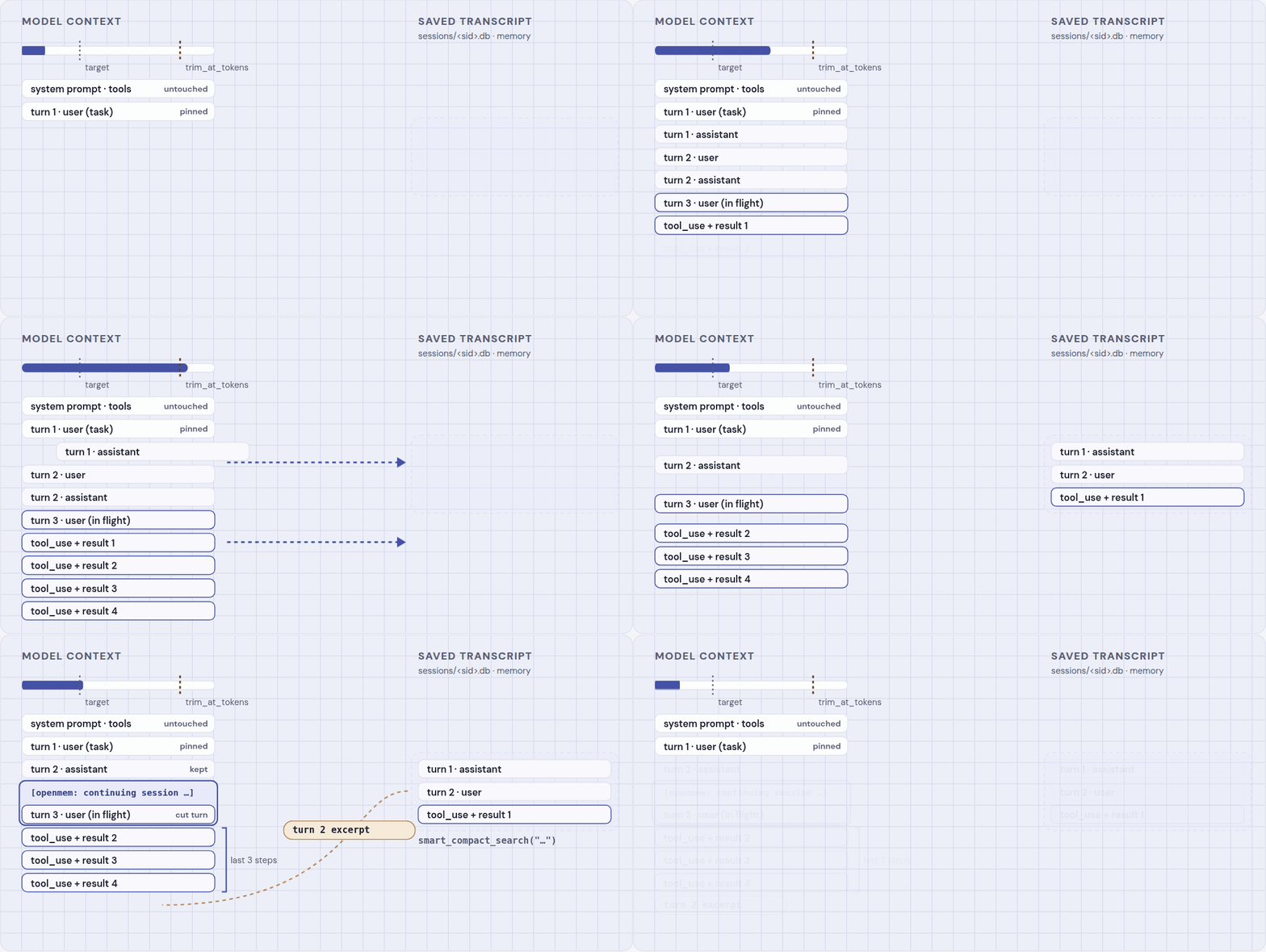
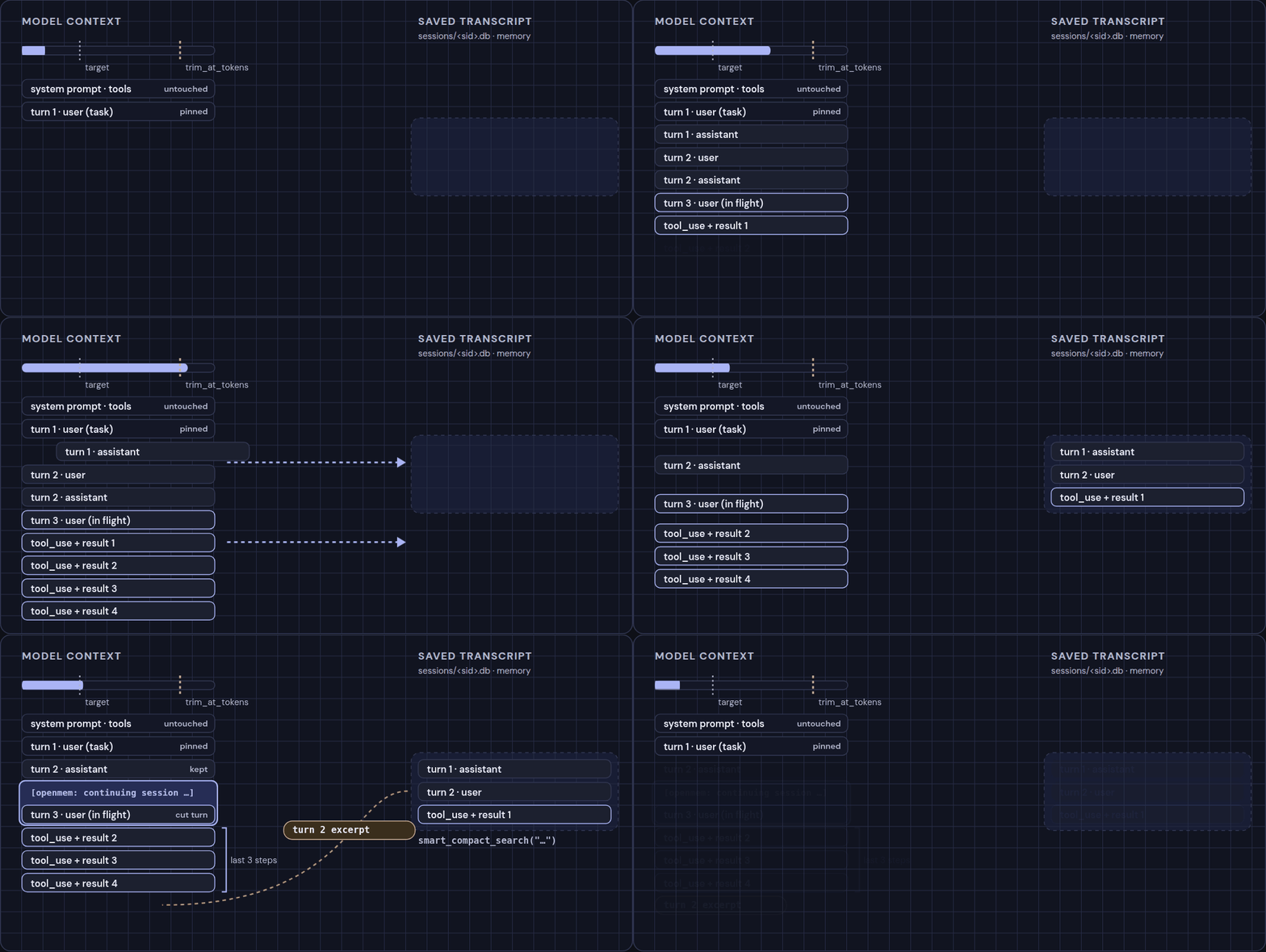
smart_compact_search pulls a detail back.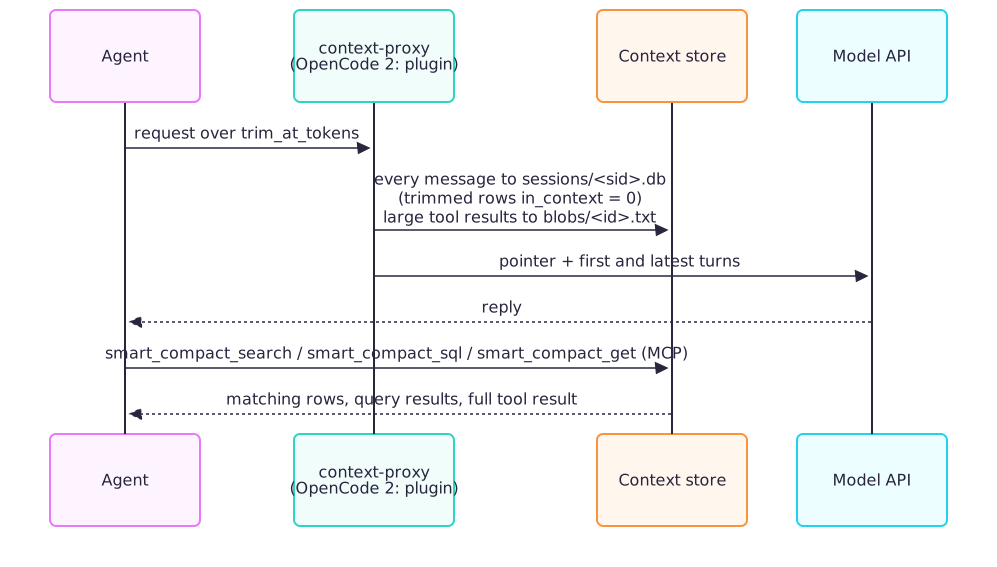
Each request goes through these steps (context proxy has implementation detail):
| Step | When | Effect |
|---|---|---|
| Tool-result compression | A tool result exceeds compress_over_tokens |
First 40 and last 20 lines stay, behind a smart_compact_get(id=...) header; the full text goes to blobs/<id>.txt |
| Store | Every request | Each message goes into sessions/<sid>.db once, keyed by a chained fingerprint, with an in_context flag (context store) |
| Trim | The request reaches trim_at_tokens, or the user typed /smarter-compact:compact |
Turns before the last real user turn, and the oldest tool exchanges of a long in-flight turn, leave the context and their rows get in_context = 0; a pointer naming smart_compact_search / smart_compact_sql replaces them. System prompt, tools, the first user turn, the reply before the last user turn, that turn and at least its last 3 tool exchanges stay verbatim, except that signed thinking leaves every kept assistant message but the latest (why) |
| Tool-result clearing and masking (on by default) | Part of each trim | Every tool result but the 10 newest, and the results in the kept turns before the latest run, become a short placeholder; the calls stay, and each result stays in the store |
Lifecycle eviction (off by default; CONTEXT_EVICTION=1, proxy) |
Every 3 assistant steps, instead of the trim | Old tool results the rules mark unneeded (a file read or written again later, a command re-run, a result nothing later refers to) become the same placeholder; the threshold trim does not run, the agent’s own compaction stays the overflow guard |
Scratchpad (on by default; CONTEXT_SCRATCHPAD=0 turns it off) |
The prompt passes CONTEXT_SCRATCHPAD_NUDGE_AT of the threshold, then the next trim |
One nudge, attached to the newest user or tool message (note placement), asks the agent to create the pad once (goal, status, decisions, facts, next step) with smart_compact_scratchpad and to update it only on a big change; every trim note opens with the current pad (≤2,500 chars) in a <compact-scratchpad> block labelled possibly stale, and snapshots it |
| Standing instruction | Every request | A constant system-prompt note tells the agent to call smart_compact_search before relying on content it cannot see |
The cut is sticky: later requests with the same history get the same rewrite byte for byte, so the prompt cache keeps hitting. A trim invalidates the cache once.
Benchmarks
Section titled “Benchmarks”ContextBench quality, time, cost and prompt-cache results: Benchmarks.
When to use it
Section titled “When to use it”| Turn it on when | Leave it off when |
|---|---|
Sessions grow past trim_at_tokens (default 125k estimated tokens, 95k for Haiku) |
Sessions stay under the limit |
| You want trimmed turns searchable, not summarized away | You cannot run litellm on the host (Claude, OpenCode 1, Codex point at the proxy) |
| You use Claude Code, Codex, OpenCode 2, or Pi | You only need MCP search hooks on Cursor or Copilot (no automatic trim) |
Turn it on
Section titled “Turn it on”smarter-compact enable claude # or codex, opencode (OpenCode 1)The plugin starts the LiteLLM proxy in the background when an agent is pointed at it. OpenCode 2 trims in-process: opencode plugin smarter-compact — no proxy URL.
Force a trim in session: /smarter-compact:compact (or agent equivalent).
Status: smarter-compact status or MCP context_status.
Agent support
Section titled “Agent support”Which agents trim on the wire, which trim in-process, and which get search tools only: Agents.
MCP tools
Section titled “MCP tools”| Tool | Purpose |
|---|---|
smart_compact_search |
FTS / hybrid search over trimmed session rows |
smart_compact_sql |
Read-only SQL on one session database |
smart_compact_get |
Text of a compressed tool result by blob id, BLOB_PAGE_CHARS (12,000) per call; returned as one header line ([smart_compact_get id=…: characters 0-12000 of N; next page: offset=12000]) then the raw text, not JSON; offset pages, max_chars (≤100,000) asks for more at once |
context_status |
Trims, fail-opens, writer versions, usage summary |
smart_compact_scratchpad |
Unless CONTEXT_SCRATCHPAD=0: view, create, str_replace, insert on the session’s pad, capped at 2,500 characters |
Wire format and SQL rules: context store.
Configuration
Section titled “Configuration”Every setting, its default and the component that reads it: configuration reference.
- Tool-result clearing and masking — what a trim replaces instead of deleting turns
- Lifecycle eviction — rule-based eviction every batch, instead of the threshold trim
- Scratchpad — the agent’s notes, shown in every trim note
- Context proxy — LiteLLM rewrite pipeline
- Context store — schema, trim rules, search tools
- OpenCode — plugin install
- Configuration — every setting and default
- Context research — related work, run notes, and benchmark method